Families Living in Poverty Have the Highest Rates of
Poverty
PovertyKid Poverty in the U.S.
· February 5, 2021
University of Maryland
The Issue:
The Us has one of the highest rates of child poverty among loftier-income countries. While government policies have played an important function in improving the material well-existence of poor children over the past four decades, much remains to exist done. The cost of driving down rates of child poverty through targeted cash transfers to depression-income families would be substantial, but it would take a relatively minor fraction of GDP. A meaningful reduction in child poverty would take positive long-term effects for the children whose lives are improved and for club at big.
Expanded safety internet programs have improved the lives of poor children in the U.S., simply millions of children continue to live in textile poverty.
The Facts:
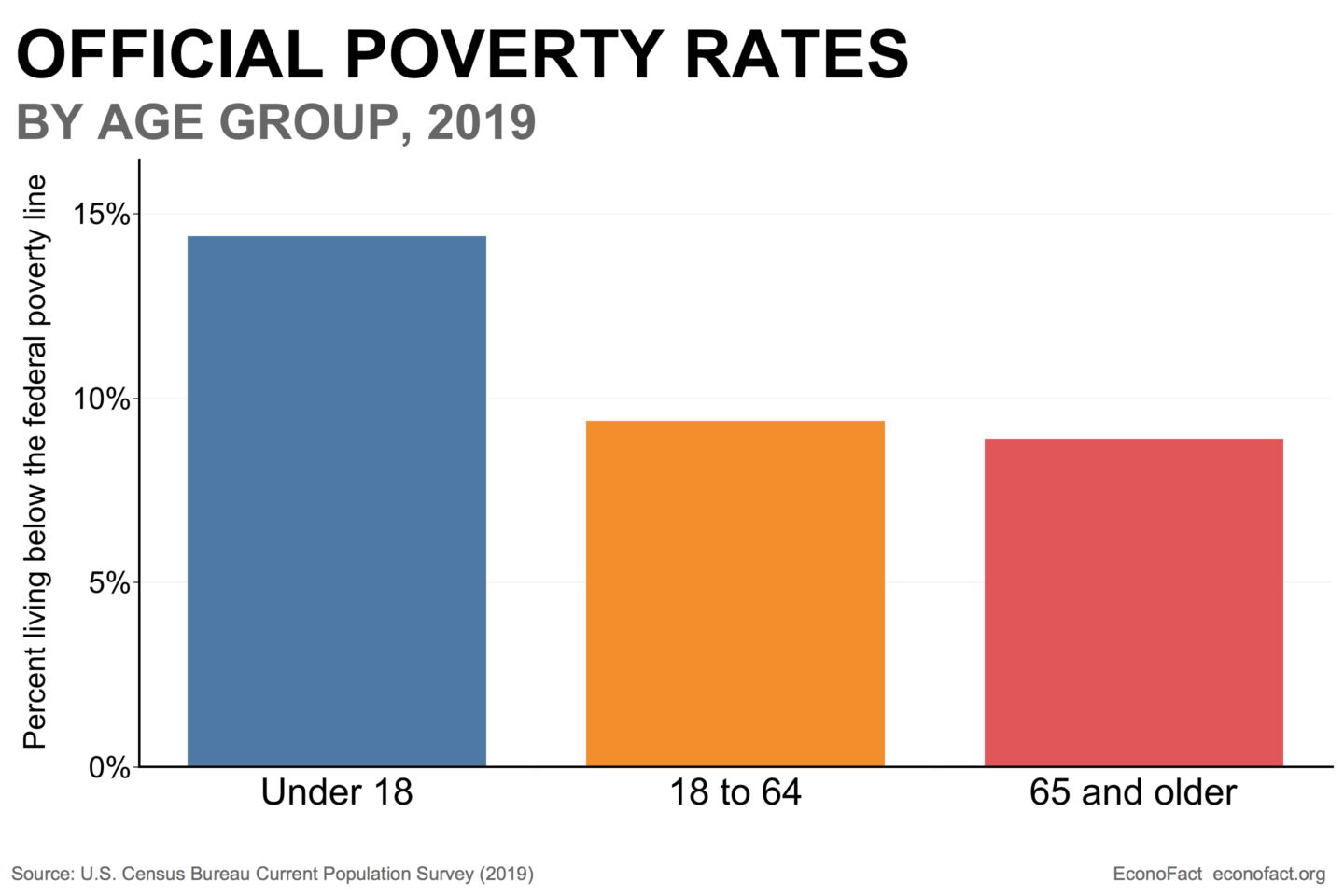
- More ten million U.S. children were officially poor before the electric current pandemic, according to regime statistics. In 2019, 14.iv percent of kids in this state, 10.46 one thousand thousand children, were living in poverty as measured by the official U.S poverty rate. This is higher than the share of adults age xviii to 64 (ix.4%) and college than the share of those 65 and over (8.nine%) who live in poverty (see chart). The official poverty rate is determined past a comparison of pre-tax family cash income – including, for example, from earnings and authorities greenbacks transfer programs, like Social Security or Temporary Assistance to Needy Families (TANF) – to the respective poverty threshold. The Census poverty thresholds were originally fix at three times the toll of a minimum food nutrition in 1963 and they have been adjusted for inflation. They vary based on family size and composition. If the sum of income is beneath the poverty threshold, all of the members of the family are classified every bit poor. The official poverty thresholds are quite low: for one developed and two children, the federal poverty line is $xx,598 per year; for two adults and two children, the federal poverty line is roughly $26,000 per year.
- There are well-known bug with the official poverty measure out. Information technology doesn't capture the contribution of some of the government programs designed to address poverty, including the Earned Income Tax Credit, since that is postal service-tax, and nutrient assistance benefits through the SNAP program, since that is not pure greenbacks. Some other major issue is that the official statistics don't account for geographic differences in the costs of living. Despite its flaws as a mensurate of textile well-beingness, tracking a consistent income-based mensurate allows scholars and policymakers to gauge how the country'southward well-nigh economically vulnerable individuals are faring and how income-based poverty rates vary across groups, places, and over fourth dimension.
- The extent of child poverty varies greatly across race and ethnic groups, as well every bit past family unit construction. Black and Hispanic children accept the highest rates of poverty in the U.S.: 26% and 21%, compared to 8.3% amidst white children and 7.3% among Asian children. Dissimilar family structures too correlate with different rates of poverty. In 2019, 41% of children in mother-only families lived in poverty, as compared to 8% in married-parent families. These poverty differences by family structure hold within race/ethnic groups as well. According to data on kid poverty rates inside race and indigenous groups, children in mother-only families are three to six times more likely to live in poverty. This largely reflects the fact that two adults bring in more than income than 1 developed. Only it also reflects the fact that parents who have lower levels of educational activity and lower levels of income are less likely to marry. Thus, single-parent family structure is both a crusade and an outcome of poverty.
- Growing up in poverty has long-term consequences for children and is very much entwined with issues of inequality and social mobility. Children who grow up in poverty have poorer physical and mental health; worse performance in schoolhouse, and, given neighborhood segregation by income, they are more probable to attend lower quality schools and alive in neighborhoods with fewer employed adults. These factors all arrive harder for children to reach their human capital letter potential and achieve college levels of income when they reach adulthood. This contributes to the relatively low level of social mobility in the The states. Based on worker productivity losses, costs to the healthcare system, and the costs of incarceration and the judicial system, a contempo written report from the National Academies of Scientific discipline estimated that child poverty costs the economy of the United States between $800 billion and $1.i trillion each year (run across here).
- The expansion of various prophylactic net programs has meaningfully improved children'due south material well-being over the last forty years. Policy efforts that accept improved children's material well-beingness over recent decades include expansions in the Earned Income Tax Credit (EITC), SNAP, and Medicaid. The affect of these programs on kid well-beingness is not readily seen in official poverty rates, since the resource these programs deliver to families are not counted in the calculation of official poverty statistics. However, using the U.South. Census Agency's Supplemental Poverty Measure, which is based on more comprehensive measures of family's resource (including from post-tax and in-kind government transfers) and costs, rates of child poverty have fallen from around xxx% in the mid-1960s to around xv% in recent years. This implies that expanded safety net programs have made a positive difference in the lives of poor children in this state, but millions of children continue to live in textile poverty.
- A social insurance programme for children could dramatically reduce kid poverty in the U.S., as Social Security has done for elderly poverty. The fact that children have the highest official rates of poverty in the U.S. is a dramatic reversal from the mid-twentieth century, when elderly poverty rates were the highest in the country. In 1959, 35% of those aged 65 and upwardly lived in poverty, versus 27% of kids and 17% of adults. Social security has been a great anti-poverty success story for the elderly in this land. We could make a like commitment to children. If each child living in poverty received a social insurance benefit equal to the boilerplate annual social security retiree do good ($17,112), child poverty would fall to less than ane%. If each kid living in poverty received half the average social security retiree benefit ($8,556), the rate of childhood poverty in the U.South. would fall below 4 percent. This would cost on the order of $179 billion and $90 billion a year, respectively. If the benefits were phased out at a rate of 70 cents on the dollar (which would conspicuously be a better policy blueprint than a cutoff at the poverty line and would additionally reduce the number of children living in near poverty weather), the almanac price estimates would be $293 billion and $118 billion, respectively. In 2019, our national Gdp was $21.4 trillion. That means that with spending in the range of 0.4% to i.4% of GDP, we could bring childhood poverty rates to less than iv or i percent.
- The economic scars of the COVID-nineteen pandemic could increment child poverty in the coming years. Child poverty was declining upwardly until the pandemic. There had been a irksome, steady refuse since the Great Recession. However, those gains could be reversed, without continued federal assistance to low-income families. The pandemic has hit low-income and vulnerable populations the hardest, both in terms of its health effects and its economic furnishings. Fortunately, the relief measures of the CARES act passed by Congress last bound helped forestall a large increase in poverty in the early months of the pandemic. Enquiry by Jeehoon Han, Bruce Meyer, and Jim Sullivan suggests that the provision of regular Unemployment Insurance, expanded Unemployment Insurance, and the Economic Affect Payments kept poverty from increasing last leap, even though there was a huge drop (14%) in employment. However, when relief provisions expire, child poverty may increase, just every bit it did during the Peachy Recession. The post pandemic path of child poverty will depend on how quickly the economy recovers, how quickly out of work parents are able to detect new jobs, and how sustained and effective government aid to low-income families is.
I way to gauge the success of a society is to evaluate how it positions itself for the future; that is, the extent to which it cares for and takes care of its children. Another guess is how the most vulnerable citizens are treated. Together, these two indicators of success propose that the United States should practise much more to alleviate child poverty. Improving the cloth well being of poor children would put them in a amend position to thrive in school and ultimately exist healthy, economically-productive adults. Investing in poor children would not only yield economic benefits for those children, but besides for society at big. While recognizing that child poverty compromises the goal of promoting economic opportunity and the future health of the economic system, it is likewise vital that we do not lose sight of the fact that poverty is a human tragedy and speaks to the moral standing of a nation. Rates of kid poverty had been falling for a number of years before the COVID pandemic hit. If the political volition is there, we could drive child poverty down fifty-fifty further in the years ahead.
Source: https://econofact.org/child-poverty-in-the-u-s
0 Response to "Families Living in Poverty Have the Highest Rates of"
Post a Comment